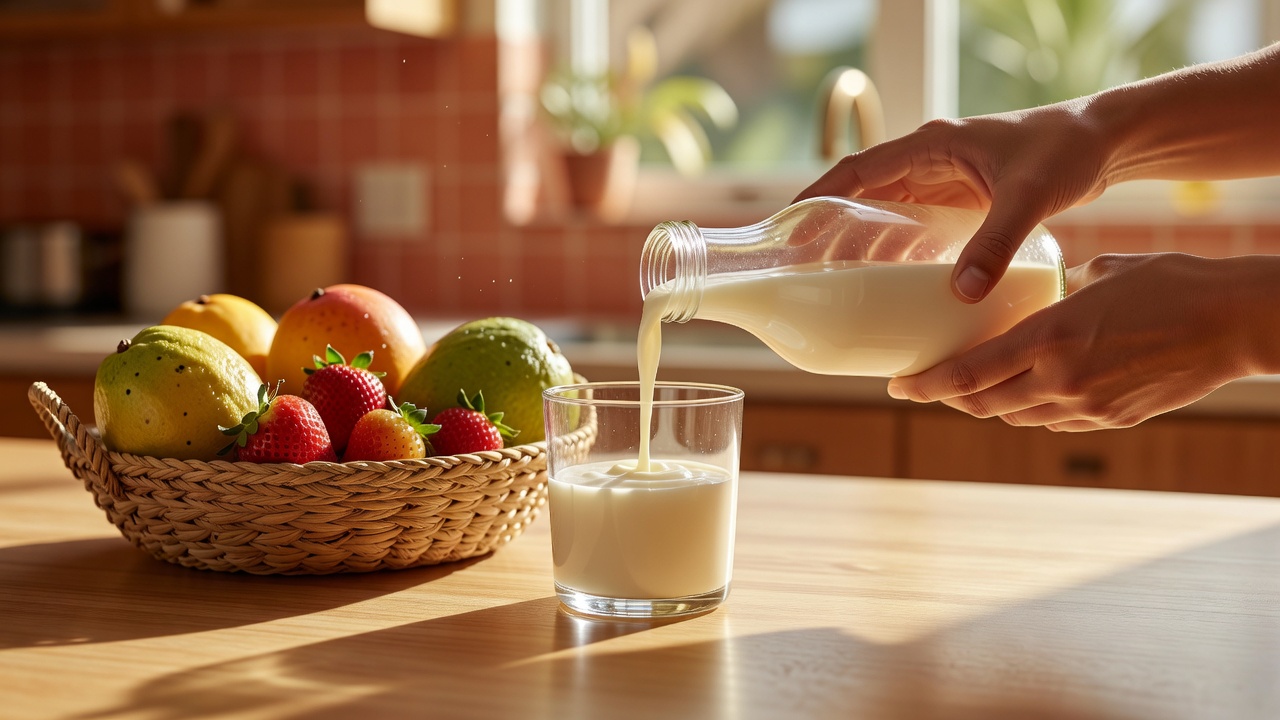
If you have ever stood in the dairy aisle holding two bottles, wondering which one to take home, you are really asking one question: what makes the best drinkable yogurt? The front of the package rarely answers it. The answer lives on the back, in the ingredient list and the nutrition panel, and once you know what to look for you can judge almost any bottle in about ten seconds. This is the same short checklist our family uses at our own Miami plant, and it works no matter which brand ends up in your cart. If you are new to the category altogether, start with our guide to drinkable yogurt and then come back here for the label details.
Start with the cultures, not the marketing
A yogurt drink is only yogurt because bacteria fermented the milk. So the first thing to look for is the phrase live and active cultures — and ideally the specific strains named on the panel. Some shelf-stable yogurt beverages are heat-treated after fermentation, which gives them a long unrefrigerated life but kills the very cultures people are buying the drink for. Neither approach is wrong, but they are not the same product. If you want the cultures, buy from the refrigerated case, check for the word live, and keep the bottle cold on the way home. Live cultures are fragile; heat and time are what wear them down.
The best drinkable yogurt has a short ingredient list
Turn the bottle around and read the ingredients in order. Milk should be first. After that, you want to recognize everything you see. Long lists tend to fill up with modified starches, gums, artificial colors and preservatives — all of which exist to make a thin, cheap base taste and pour like a rich one. A well-made yogurt drink gets its body from the milk and the fermentation itself, not from thickeners. Our own bottles carry no artificial sweeteners, colors, preservatives or starches, and the milk is non-GMO. That is not a marketing flourish; it is simply what happens when you do not need to prop the product up.
Know your sugar, and know the names
Sugar is where most shoppers get tripped up, partly because brand naming is inconsistent across the category. Yogurt naturally contains some milk sugar, so a bottle will never read zero. What you are looking at is added sugar. At YoguRico the distinction is simple: Natural (No Sugar Added) is our unsweetened bottle and our lowest-sugar option by a comfortable margin, while Plain is lightly sweetened — mild and classic, but not the sugar-free one. People often assume that the word plain means unsweetened everywhere they shop, and it frequently does not. Read the panel rather than the name, and if you are cutting back, reach for the bottle that says so explicitly.
Protein and calcium are the quiet workhorses
The nutrition panel tells you whether a drink is a treat or actual nourishment. Our 7 oz bottle carries 7 grams of protein and roughly 260 mg of calcium — enough to make it a real component of a breakfast rather than a beverage you drink alongside one. Protein is what keeps a morning drink from evaporating by ten o'clock, and calcium contributes to the bone-building work that goes on quietly in the background at every age. If you want to see where a bottle fits into your own day, our protein calculator and calcium calculator will do the arithmetic for you in a few clicks.
Real fruit purée versus natural flavors
Here is a distinction worth being precise about, because plenty of labels blur it. Real fruit purée is a genuine ingredient with genuine cost, and it is not in every flavor of anything. In our line it appears in exactly three: Guava, Guanabana and Coconut. Our other flavors — Strawberry, Mango, Pineapple, Strawberry Banana and the rest — are made with natural flavors instead, and they are excellent, but we are not going to tell you there is purée in them when there is not. When you are comparing brands, look for purée named in the ingredient list rather than fruit pictured on the front. The photograph is not an ingredient.
Size and format matter more than you would think
The best bottle is the one that actually gets drunk. A 57 oz jug is the right call for a household that pours it at breakfast, blends it into smoothies, and cooks with it — it is the better value per ounce and it lives in the fridge door. A 7 oz single is the right call for a lunchbox, a gym bag, a desk drawer or a car cupholder, because it needs no cup and no cleanup. We make 7 oz singles in Strawberry, Mango and Plain. Most people we talk to end up buying both sizes for different jobs, which is exactly how we use them at home.
Lactose sensitivity does not rule you out
Fermentation consumes part of the lactose in milk, which is one reason some people who avoid a glass of milk tolerate a yogurt drink comfortably. Tolerance varies quite a bit from person to person, though, so if dairy has been a problem for you, start with a small serving and go from there. We also make lactose-free versions of Plain and Strawberry for anyone who would rather not experiment. As with anything digestive, if symptoms are persistent it is worth a conversation with your doctor rather than a guess in the dairy aisle.
How we would summarize the checklist
Live cultures, a short and legible ingredient list, honest sugar labeling, meaningful protein and calcium, and a format that fits your week. Five checks, ten seconds. We have been making drinkable yogurt in Miami since 2010 as a family business — Pura Vida Dairy — and we built our bottles around that list because it is what we wanted for our own kitchen table first. Rico, our little cow, would tell you the same thing if he could talk.
Common questions
Is the best drinkable yogurt always the most expensive one? No. Price tracks packaging and marketing at least as much as quality. Compare cultures, ingredients and the nutrition panel, then compare price per ounce — the larger bottle is usually the better deal.
How long does it keep once opened? Treat it like milk: keep it refrigerated, close it tightly, and go by the date on the bottle. Cold storage is also what protects the live cultures.
Can I cook or blend with it? Absolutely. It works in smoothies, overnight oats, marinades and dressings. The recipes on our blog are a good place to start.
Is it a good breakfast on its own? It is a strong start — protein, calcium and live cultures in one bottle — and better still with fruit or something whole grain alongside it. General wellness, as always, comes from the overall pattern of what you eat rather than any single item.
Ready to run the checklist on a real bottle? Use our store locator to find YoguRico near you, turn the bottle around, and see how it reads.
🥤 Goes great with our Strawberry Banana drinkable yogurt — see nutrition facts & sizes.
{# Guaranteed blog links: circular previous/next, so every post links to two others and every NEW post instantly gets inbound links from old posts. #}