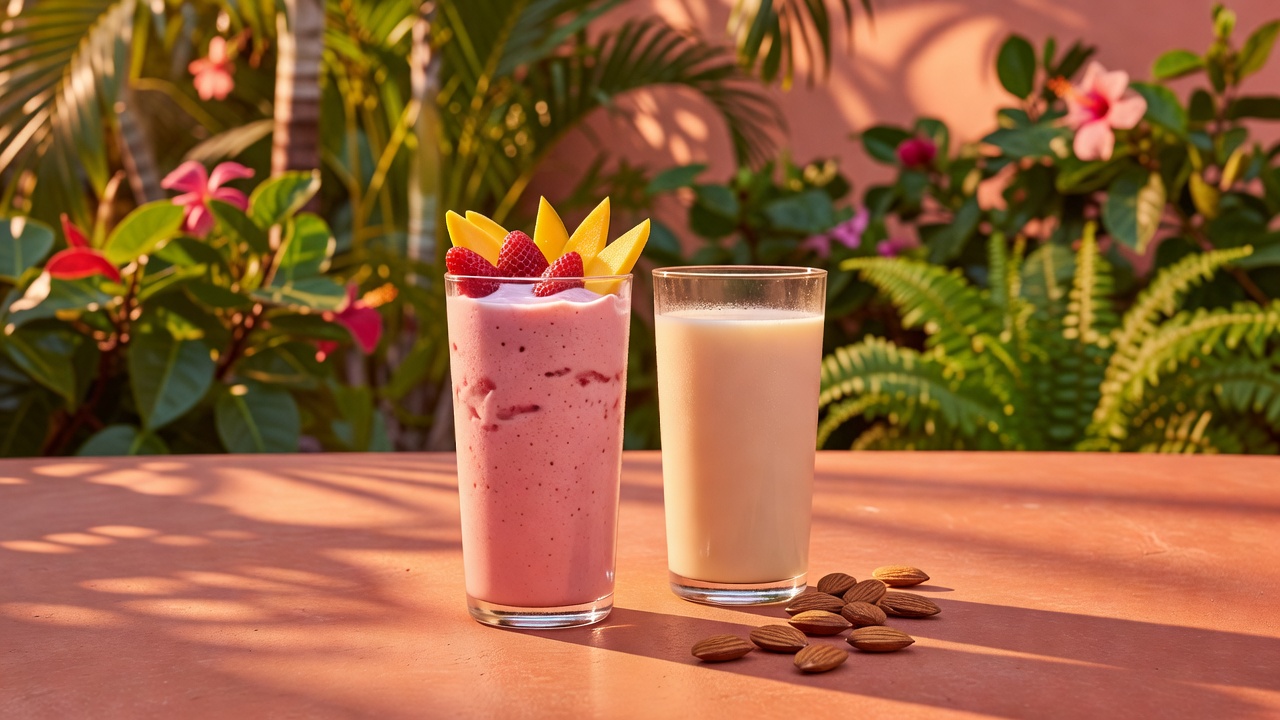
If you are standing in the refrigerated aisle holding a carton in each hand, the drinkable yogurt vs almond milk question usually comes down to one thing: what do you actually want this drink to do for you? Both are poured into the same glass, both can be sipped on the way out the door, and both have loyal fans. But nutritionally they are built very differently. One is fermented dairy with live cultures and real protein. The other is a plant beverage made mostly from water and a small amount of almonds. Knowing which is which makes the choice easy.
Drinkable yogurt vs almond milk: the short answer
If you want protein, calcium and live probiotic cultures in a single pour, drinkable yogurt is the stronger choice. If you want a very low-calorie, dairy-free liquid to splash into coffee, cereal or a smoothie base, unsweetened almond milk does that job well. They are not really competitors so much as two different tools. Many families we talk to in Miami keep both in the fridge and reach for whichever one fits the moment.
For a fuller breakdown of what fermented dairy drinks are and how they differ from spoonable cups, our guide to drinkable yogurt covers the basics in one place.
What is actually inside each carton
Drinkable yogurt starts as milk. Live cultures are added, the milk ferments, and the result is a smooth, pourable yogurt with a gentle tang. At YoguRico we use non-GMO milk and nothing artificial: no artificial sweeteners, no artificial colors, no preservatives and no added starches. The texture comes from fermentation, not from thickeners.
Almond milk starts as almonds and water. Most commercial versions are roughly two percent almonds by weight, blended, strained and then fortified. That fortification matters, because without it almond milk would carry very little calcium or vitamin D on its own. Many brands also add a stabilizer such as gellan gum or locust bean gum to keep the drink from separating, plus salt and natural flavor. None of that is alarming, but it does mean the nutrition on the label is largely added rather than inherent.
Protein is the biggest gap
This is where the drinkable yogurt vs almond milk comparison stops being close. A 7 oz bottle of YoguRico delivers about 7 grams of complete dairy protein. Unsweetened almond milk typically provides around 1 gram per cup. That is not a small difference when you are trying to build a breakfast that actually holds you until lunch.
Protein is what makes a drink feel like food instead of a beverage. It slows how quickly you feel hungry again and supports muscle maintenance as part of a balanced diet. If you are curious how much you personally need in a day, our protein calculator gives you a quick estimate based on age and weight.
Calcium and bone support
Both drinks can deliver calcium, but they get there by different routes. A 7 oz YoguRico gives you roughly 260 mg of calcium that comes naturally from the milk itself, alongside the protein and other dairy minerals that travel with it. Fortified almond milk can list a comparable calcium number, but it is calcium added during processing, and it arrives without the protein package.
One practical note: fortified plant milks settle. The added calcium sinks toward the bottom of the carton, so a poorly shaken glass may not contain what the label promises. Shake it well. If bone nutrition is your main reason for drinking either one, our calcium calculator is a simple way to see how a daily serving fits into your target.
Only one of them is fermented
Almond milk is blended and pasteurized. It is not fermented, so it contains no live cultures at all. Drinkable yogurt is defined by fermentation, and every bottle of YoguRico carries live and active probiotic cultures. Those cultures are the reason many people reach for a yogurt drink in the first place, since fermented dairy supports digestion as part of a balanced diet.
If gut health is your goal, that difference is decisive, and there is no version of almond milk that closes it. Some plant beverages are cultured, but standard almond milk is not one of them. This is also worth keeping in mind if you are choosing a drink for a child; a pediatrician is the right person to ask about what fits your family, especially where allergies are involved.
Sugar, sweeteners and reading the label honestly
Here is where people get tripped up. Sweetened vanilla almond milk can carry as much added sugar as a sweetened yogurt drink, sometimes more, while still wearing a health halo because it is plant based. Meanwhile, part of the sugar listed on a yogurt label is lactose, the sugar that occurs naturally in milk, not something added in the plant.
The fix is the same on both sides of the aisle: read the added sugars line rather than the total. If you want the lowest-sugar option we make, that is Natural (No Sugar Added), which is genuinely unsweetened. Our Plain is lightly sweetened, so it is a mellow everyday flavor rather than the no-sugar pick. Either way, you will never find an artificial sweetener in a YoguRico bottle.
Taste, texture and how people really use them
Almond milk is thin, faintly nutty and deliberately neutral. That neutrality is its strength in coffee, oatmeal and cereal, where you do not want the liquid to take over. Drinkable yogurt is creamier and tangier, which makes it satisfying on its own and excellent as a smoothie base, since it brings body without needing added thickeners.
Flavor is the other honest difference. Almond milk comes in a handful of variations. Drinkable yogurt gives you a much wider range, and in our case a distinctly tropical one: Strawberry, Mango, Pineapple, Strawberry Banana, Plain, Natural, and the three flavors we make with real fruit purée, Guava, Guanabana and Coconut. That variety is a big part of why a yogurt drink tends to get finished and a carton of plain plant milk sometimes does not.
Allergies and who should choose which
Almond milk is a tree nut product and is not appropriate for anyone with a nut allergy, which is a common restriction in schools. Drinkable yogurt is dairy, so it is not an option for someone with a milk allergy. For lactose sensitivity specifically, the picture is friendlier than many people expect: fermentation reduces the lactose in yogurt, and we also make lactose-free Plain and Strawberry for people who want to remove the question entirely.
Choose almond milk when you need a dairy-free, low-calorie liquid for coffee or cooking. Choose drinkable yogurt when you want the drink itself to count as nourishment, with protein, calcium and live cultures doing real work.
Common questions
Is almond milk healthier than drinkable yogurt? Neither is universally healthier. Unsweetened almond milk is lower in calories; drinkable yogurt carries far more protein, more naturally occurring calcium and live probiotic cultures. The better answer depends on what you need from that glass.
Can I mix them? Yes. A splash of almond milk thins a yogurt smoothie nicely without watering down the flavor. Blend a bottle of Mango with a little almond milk and ice for an easy afternoon drink.
Which is better after a workout? Drinkable yogurt, mainly because of the protein and the fluid together. Almond milk on its own does not supply meaningful recovery protein.
Is drinkable yogurt vs almond milk a real decision for kids? For growing children, protein and calcium matter, and almond milk is not a nutritional substitute for dairy in that role. Talk to your pediatrician about what fits your child, particularly if allergies are a factor.
Still deciding? The easiest way to settle the drinkable yogurt vs almond milk debate is to taste one. YoguRico has been made by our family in Miami since 2010, in 57 oz bottles for the fridge and 7 oz bottles for lunch bags. Find YoguRico near you and see which one earns the spot in your door shelf.
🥤 Goes great with our Strawberry Banana drinkable yogurt — see nutrition facts & sizes.
{# Guaranteed blog links: circular previous/next, so every post links to two others and every NEW post instantly gets inbound links from old posts. #}