I make drinkable yogurt for a living. My family and I run a yogurt manufacturing operation in Florida, and "is the drinkable kind better for probiotics?" is one of those questions I hear constantly — from shoppers, from buyers, sometimes from people in the industry who should know better.
So let me give you the honest answer, not the marketing answer. The honest answer is that the format barely matters. What matters is what's actually in the bottle. Let me walk you through why — and how to tell a real probiotic yogurt from sugar-water dressed up to look like one.
First, clear up the biggest misconception
Most articles about this lump all the bacteria in yogurt into one bucket called "probiotics." That's wrong, and the mistake is the source of a lot of confusion. There are really two jobs being done by the cultures in your yogurt:
- Starter cultures are what turn milk into yogurt. They do the fermentation — eat the lactose, produce lactic acid, thicken the milk, and create that tangy flavor. Every yogurt on earth has these. They are not, by themselves, the reason people buy yogurt for "gut health."
- Probiotic cultures are the ones delivering the extra health benefits people are after. In our process, the probiotics are an added ingredient — a deliberate addition, not an automatic byproduct of making yogurt.
That distinction is everything. If a yogurt — drinkable or spoonable — doesn't have probiotic cultures added, you're getting the texture and the flavor, but not the functional benefit you think you're paying for. And whether a product has them comes down to the manufacturer's choice. It is brand-by-brand, not format-by-format.
Meet the strains: what each probiotic actually does
We use three live probiotic strains, and each one pulls its own weight:
- Bifidobacterium animalis subsp. lactis — the housekeeper. Helps keep you regular, easing both constipation and diarrhea (including the kind that follows antibiotics). It feeds the good bacteria in your gut, crowds out the bad ones, and gives your immune system a bit of backup.
- Lactobacillus delbrueckii subsp. bulgaricus — the peacekeeper. Produces lactic acid that keeps your gut balanced and unwelcoming to harmful bugs, helps your body handle lactose, and calms things down when digestion gets irritated. Some studies even link it to fewer common colds, especially in older adults.
- Streptococcus thermophilus — the lactose specialist. Excellent at breaking down lactose, which is a big reason many people who struggle with milk can still enjoy yogurt. It also keeps the gut slightly acidic, which helps block harmful bacteria.
And the most important part: they work as a team. These three do more together than any one alone — they make the yogurt, support smooth digestion, help with lactose, and keep your gut balance healthy.
A fair, honest note: these are well-studied benefits, but results vary from person to person and depend on dose and formulation. Think of this as what these strains support and help with — not a cure for anything.
So does the liquid format hurt the probiotics?
This is the real heart of the headline question, and the answer is no — not in any meaningful way. The cultures don't care whether the final product is thick enough to hold a spoon or thin enough to pour. The strains we use are thermophilic — built for yogurt-making and thriving at fermentation temperatures. Here's roughly how it works in our facility:
- Streptococcus thermophilus and Lactobacillus bulgaricus grow fast at 99–113°F, peaking around 108°F. A standard ferment runs near 104°F for roughly 8 hours.
- Bifidobacterium lactis grows more slowly, but survives well alongside the other two and holds up in the acidic environment they create.
- By the end of fermentation, viable counts typically land at 10⁸–10⁹ CFU per milliliter — hundreds of millions to over a billion live organisms per milliliter.
None of that is affected by whether the end product is drinkable or spoonable. The fermentation is the same. The strains are the same. The biology doesn't change because you're going to drink it instead of scoop it. The real trick to keeping probiotics alive isn't the format — it's the delicate balance of temperature, time, and pH.
What about by the time you actually drink it?
A fair follow-up: cultures are alive at the plant, sure — but are they still alive in your fridge three weeks later? This is where shelf life and cold chain come in. Stored properly at 40°F, with pH controlled (around 4.0–4.6), oxygen minimized, and no temperature abuse, our strains hold good viability across a 90-day refrigerated shelf life. Counts decline gradually — often half a log to a log across 30–90 days — but well-made probiotic yogurts routinely still deliver at least 10⁶–10⁷ CFU per serving by the time you drink them.
The takeaway for a shopper: keep it cold, don't let it sit warm in the car, and respect the date. The format on the label has nothing to do with this — a spoonable yogurt that gets temperature-abused loses cultures just as fast as a drinkable one.
The verdict: it's basically a wash
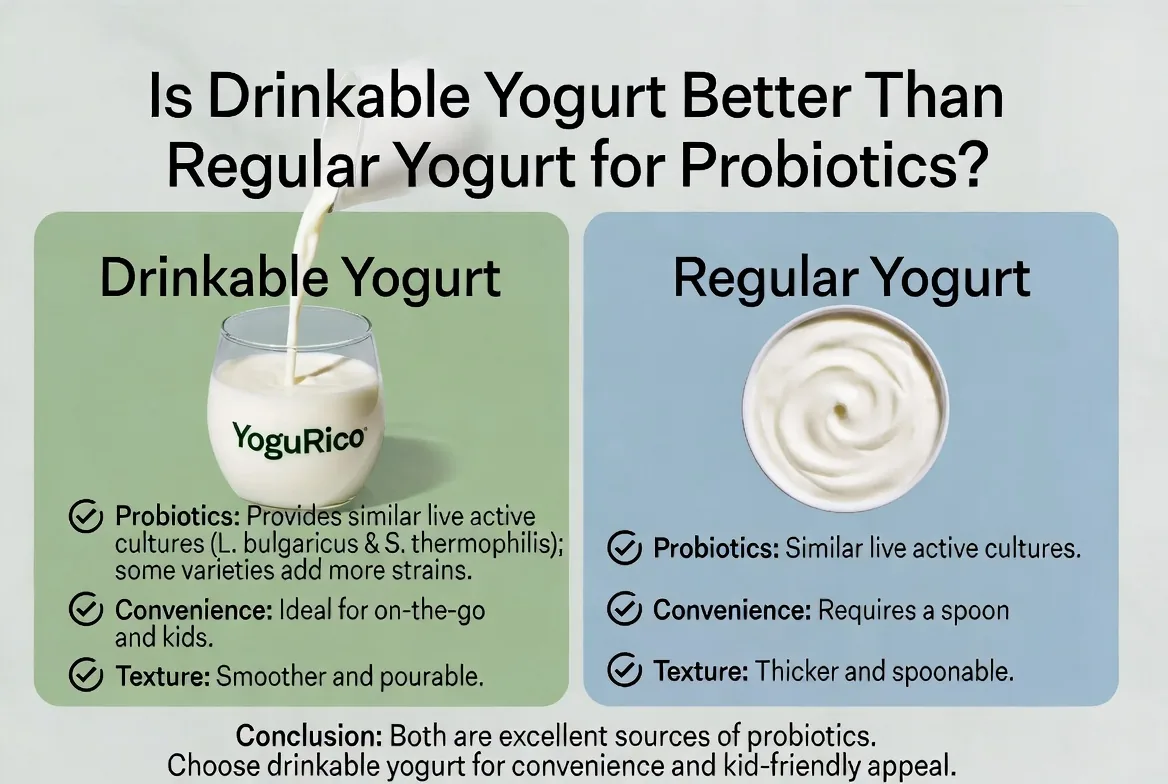
If a drinkable yogurt and a spoonable yogurt have the same probiotics and both are made and stored properly, the difference comes down to one thing: do you want to drink it or spoon it? That's it — convenience and personal preference. On the go, in a lunchbox, for someone who doesn't love thick textures, drinkable wins on practicality. At the breakfast table with granola and fruit, spoonable might feel better. Neither is "better for probiotics." Anyone telling you the liquid format is inherently superior for gut health is selling you something. So is anyone telling you it's inferior.
How to actually pick a good one in the aisle
Since the format isn't the deciding factor, here's what is. When you're standing in the dairy case comparing two drinkable yogurts:
- Look for at least three named live cultures. A serious probiotic product lists multiple named strains, not just a vague "contains live and active cultures" stamp. Our blend — B. lactis, L. bulgaricus, and S. thermophilus — is an example of a real working culture blend.
- Check that there's no added water. This is one of my biggest tells. A real drinkable yogurt gets its pourable consistency from how it's made — not from watering down yogurt to stretch it out. If you see water in the ingredient list, you're often paying yogurt prices for diluted product.
Those two rules alone filter out a surprising amount of what's on the shelf.
The sugar question — and an important nuance
The most common knock on drinkable yogurt, especially the kid-targeted stuff, is sugar. It's fair, but there's a distinction worth understanding. Every yogurt made with milk contains sugar — because milk naturally contains lactose. You cannot make a real dairy yogurt with zero sugar, so "0g sugar" on a milk-based yogurt is usually a sign of artificial sweeteners doing the work.
The number that actually matters is added sugar. In our line, the Natural, no-sugar-added option has only what's there from the milk. On the flavored varieties, we do add sugar — honestly — to make them taste good enough that people want to drink them. Take our best-seller, Strawberry: it's the one people reach for first, and yes, it has a bit of added sugar so it tastes good enough to enjoy every day. There's a real tension between "tastes great" and "as clean as possible," and I'd rather be upfront about it. The move as a shopper is to read the added sugar line, not the total sugar line.
Who benefits most — and who should be a little careful
The strains' benefits center on digestive support, lactose digestion, and gut balance, with some research pointing toward immune support too. The fair caveat stands: results vary by person, dose, and formulation — this is "supports digestive health" territory, not medicine.
So who gets the most out of it? The convenience of the drinkable format genuinely helps certain people stay consistent: busy people, kids, anyone on the go, and people who don't enjoy thick textures. If a format makes you actually consume it daily, that consistency is worth a lot. Who should be cautious? Anyone watching added sugar should stick to no-sugar-added or natural varieties. And severely lactose-intolerant folks should still pay attention to how a given product sits with them, even though the cultures help.
A fair word for spoonable yogurt
I make drinkable, but I'll give the spoonable side its due. Spoonable — especially Greek-style — tends to be more nutrient-dense per ounce, since it isn't thinned out: often more protein and calcium per serving, and a stronger "this is a meal" feeling. If your priority is protein density or satiety, spoonable has a real edge. Drinkable's honest trade-off is that it can feel less filling, and a poorly made one risks separation over time. Which brings me to something I'm proud of: separation — syneresis, that watery layer on top — is the classic flaw in drinkable yogurt, and we've figured out how to prevent it in ours. That's not a given in this category.
What I actually want you to walk away with
We're a family-owned business, and we formulated our drinkable yogurts for our own family to drink. That's not a marketing line — it's the reason the products are the way they are. Natural flavors. Natural colors. No starches. No artificial sweeteners. No preservatives. And we didn't start doing that because new regulations forced everyone's hand. We've always stood for it. No junk, period.
So when you're deciding between drinkable and regular yogurt for probiotics, stop asking which format is better. They're more or less equal. Ask the questions that actually matter: Does it have real, named, live probiotic strains? Is it made with real ingredients and no junk? Is it kept cold and within date? Get those right, then pick whichever one you'll actually enjoy and keep drinking — that consistency is where the real benefit lives. When you're ready, you can find YoguRico near you.
Frequently asked questions
Does drinkable yogurt have probiotics?
It can, but it isn't automatic. Probiotics are an added ingredient, not a guaranteed byproduct of making yogurt. Some drinkable yogurts contain added probiotic strains and some don't — it comes down to the manufacturer, not the format. Check the label for named live strains.
Is drinkable yogurt as good as regular yogurt for gut health?
Yes, when both contain the same live probiotic cultures and are stored properly. The fermentation and the bacteria are the same whether the final product is thick or pourable. The difference is mostly convenience and preference.
How can I tell if a drinkable yogurt actually has live probiotics?
Look for at least three named live cultures on the label, and check there's no added water in the ingredients. Vague "contains live and active cultures" wording without named strains, or watered-down ingredient lists, signal a weaker product.
Does drinkable yogurt have a lot of sugar?
It depends on the variety. All milk-based yogurt contains some natural sugar (lactose). The number that matters is added sugar — flavored varieties often add sugar for taste, while natural varieties may have none added. Read the added-sugar line, not just total sugar.
Are the probiotics still alive when I drink it?
If it's kept refrigerated at about 40°F and consumed within its date, yes. Live counts decline slowly over shelf life, but well-made probiotic yogurts still deliver millions of live organisms per serving at the end of a typical 90-day refrigerated shelf life.
🥤 Goes great with our Strawberry drinkable yogurt — see nutrition facts & sizes.
{# Guaranteed blog links: circular previous/next, so every post links to two others and every NEW post instantly gets inbound links from old posts. #}